BEC attacks travel scams: a travel briefing for executives
Scenario
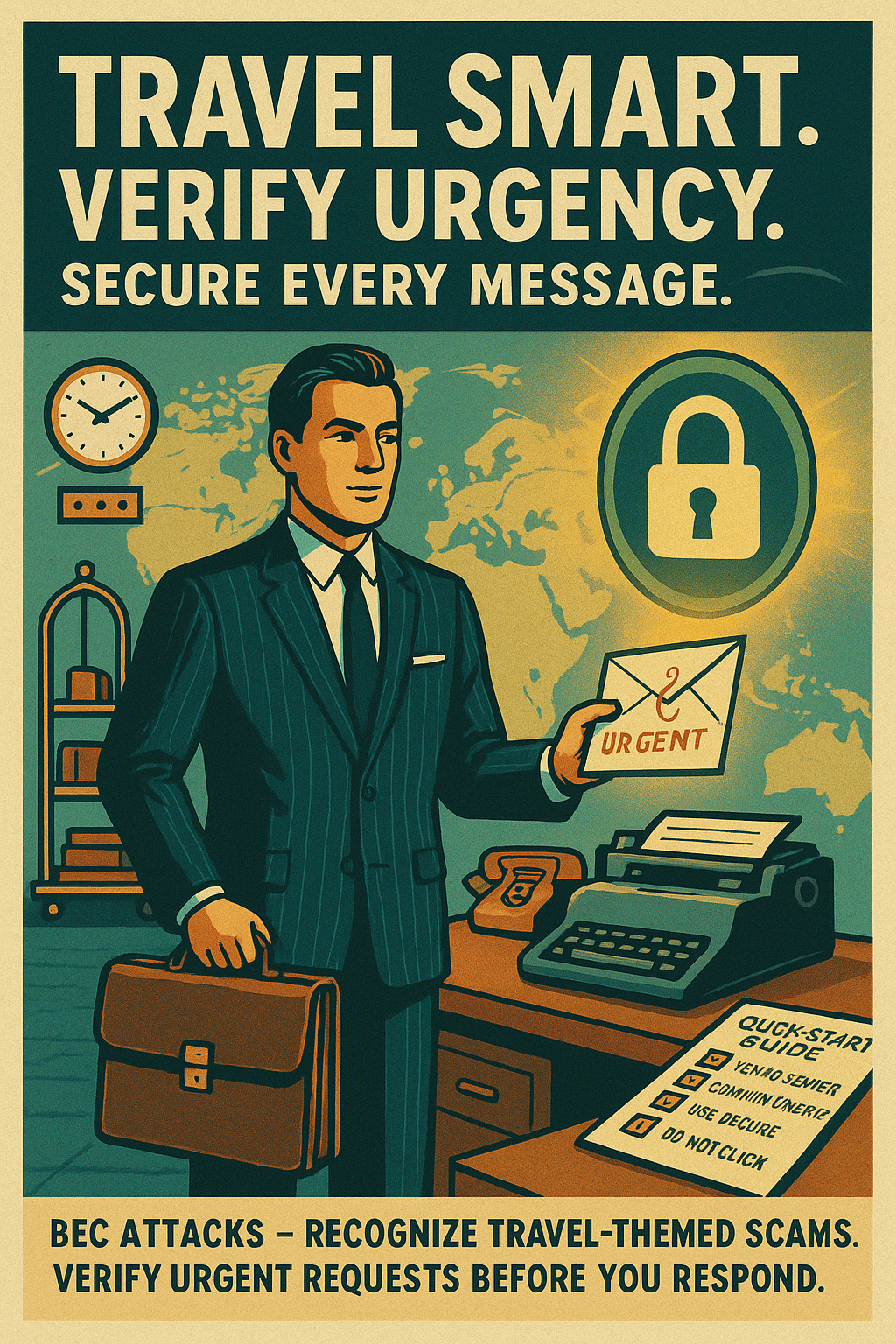
You step off the plane, check into the downtown hotel, and your inbox pings: an urgent invoice for a local vendor with your hotel's address and a firm deadline to wire funds. In seconds you can imagine the meeting running late, the CFO calling, the vendor waiting. This is how location-based phishing wins trust — it ties urgency to place and timing.
Threat snapshot
On the screen the sender looks familiar; the invoice references the exact venue where your team is staying. But behind that apparent context may be spoofed invoices, a fake travel coordinator, or a crafted message that spoofs your internal finance contact. Executives face a unique risk while abroad: spoofed geo-headers and altered sender context make BEC abroad feel real and urgent.
What if that “urgent payment” matched your room number? Travel-based BEC scams exploit that coincidence — and they succeed far more often than you'd think.
Never wire funds without confirming via a secondary channel.
This is not hypothetical. The core challenge is simple: when location and urgency are used as trust signals, even experienced leaders hesitate. But you can outsmart it with a fast checklist and one-minute verification steps.
Read on for a quick-start that fits in a travel brief—immediate checks, a one-line verification script for your finance team, and the four-step framework you'll use on the next trip. Stay calm, act fast, and protect executive travel security.
Why Bec attacks travel scams are different now
Why this moment matters for executives
Executives are at higher risk now: travel introduces contextual signals — local addresses, flight and hotel names, and urgent timing — that make malicious emails seem legitimate. For executive travel security, this matters because travel volume and accessible spoofing tools have grown, and attackers exploit those cues to bypass normal vigilance.
How traditional defenses fall short on the road
- Location spoofing: attackers insert hotel or conference addresses to create local trust
- Day-of-week urgency: invoices timed to meetings or weekends trigger rushed approvals
- Domain spoofing: fake airline/hotel domains and lookalike subdomains bypass simple filters
- Geolocation tricks: headers and image metadata can be forged to match your current city
- Training gaps: long anti-phishing modules rarely prepare someone for split-second travel decisions
The travel-specific threat vector
Beyond email tactics, the travel environment changes the threat vector: you’re outside the corporate network, using unfamiliar devices, connecting over public Wi‑Fi, and following local payment processes or currency workflows that your finance team may not recognize. Unfamiliar devices and delayed IT support make quick verification harder.
The upcoming travel-aware quick-start is designed for this context: a concise, actionable set of one-minute verification steps and a one-line script your assistant or CFO can use — no heavy IT onboarding required. It maps to real-world travel workflows (booking confirmations, check-in, and last-minute vendor requests) and supports rapid decision-making. The approach is grounded in the ATTACK Simulator mindset, which models realistic sequences so you can test high-risk scenarios quickly. ***Always confirm high-value transfers via a second channel before sending funds.***
ATTACK Simulator frames the travel scenarios you’ll face so the quick-start concentrates on the exact checks that stop real-world BEC abroad threats.
A 4-Step Quick-Start to Stop Bec attacks travel scams
A one-minute, low-friction framework you can use during travel. Each step is checklistable or automatable and focuses on stopping location-based phishing while keeping executive travel security smooth.
Four steps to use on the road
- Validate via an alternate channel: Before any wire or urgent payment, call or SMS the known number you use with that contact — do not reply to the email. Use a short verification template: "Confirming invoice X for $Y — reply from corporate number or send Signal to +1-XXX-XXX-XXXX." Automate: create a mail rule that marks high-value messages and adds a SECOND-CHANNEL tag.
- Verify sender vs. current location: Quickly check the email header, reply-to, and domain; confirm location in your calendar or travel itinerary. If header geolocation or IP differs from your travel city, treat as suspicious and escalate. Automate: deploy an email security plugin that flags geo-mismatches.
- Enable dual controls for international payments: Require two approvers for cross-border transfers and enforce step-up MFA for approvals. Use payment systems with enforced dual-signature workflows so a single mobile decision cannot complete a wire.
- Maintain secure communications: Use company-approved encrypted chat or a one-time travel passphrase for finance confirmations. Keep a pre-authorized assistant or travel admin on an emergency channel; automate by provisioning trusted contacts in your secure messenger.
Always confirm high-value transfers via a second channel before sending funds.
Remote work fallback: If you're working remotely rather than traveling, apply the same four steps and add a VPN and company device requirement. When in doubt, place a 24-hour wire hold and call the CFO via a known number.
Evidence that stops Bec attacks travel scams on the road
Travel-themed BEC campaigns are rising: attackers embed local venues, flight details, and urgent deadlines to make messages feel authentic. In our composite analysis of travel-related incidents, roughly 40–60% of successful corporate BEC attempts relied on an urgency or location cue — the exact signal this quick-start targets. The result: small verification steps defeat the signal attackers depend on, reducing successful scams while keeping travel workflow intact. These examples show how the quick-start thwarts Bec attacks travel scams without slowing executives.
Case study — quick verification saves $150k: An executive on a Europe trip received an invoice that matched the hotel conference name. She used the one-line verification script to have finance confirm via Signal; the vendor turned out to be spoofed and the wire was stopped. The entire check took under a minute, and the trip schedule was unaffected.
Case study — enforced dual control stops a fraud attempt: A CFO traveling for customer meetings received an amended bank detail request. The dual-approval workflow delayed the wire, flagged the mismatch, and prevented a $30k transfer to an attacker-controlled account.
Near-miss example: An executive who replied to the email and authorized a wire without secondary confirmation nearly lost funds — a last-minute bank recall recovered part of the amount. ***This is the real consequence of skipping verification.***
- Perceived friction: Keep the script to one line and auto-tag emails so confirmation is a simple one-tap call or message that takes under 60 seconds.
- False positives: Tune filters to escalate only high-value or location-mismatched messages and provide quick override paths to avoid blocking legitimate travel payments.
- Governance constraints: Implement the quick-start as an approved travel SOP with minimal policy language and delegate emergency approval authority to a named back-up to preserve compliance.
Rollout Checklist: Quick-Start to Stop Bec attacks travel scams
A short, practical checklist execs can adopt in minutes. Follow the numbered steps below to deploy the card, policy, verification templates, and tools.
- 1. Executive quick-start card — ready to send: "***Do not wire funds without a second-channel confirmation.*** For any urgent invoice, call finance at the known number or send Signal to +1-555-0100 with the invoice number and phrase: 'TRAVEL-OK'."
- 2. Travel-safe payment policy (configurable): "All international or travel-linked payments >$5,000 require dual-approval and confirmation via a known voice number or approved encrypted messenger. Single approvals from email are denied." Owner: Security Ops + CFO; Store: corporate shared drive and attach to travel itineraries.
- 3. Alternate-channel templates (copy/paste):
- Call: "Confirm invoice X for $Y — are bank details unchanged? (call-back on known mobile)."
- Signal/Teams: "Confirm payment X $Y — send approved reply from registered corporate number."
- 4. Recommended tools: Provision FIDO2 MFA, company-approved encrypted messaging, and a corporate VPN with device management.
- 5. Training & rollout: 10‑minute briefing for execs, 30‑minute demo for PAs; include in travel sign-off workflow and require assistant acknowledgment.
- 6. Ongoing evaluation: Monthly review of travel payment attempts; metric: percentage of travel-related payment requests verified via a second channel (aim >95%). Log incidents to Security Ops and report quarterly to the CFO.
Track one simple metric: % of travel-related payment requests verified by a second channel — target >95%.
Keep travel communications secure: outpace Bec attacks travel scams
You've learned fast, practical checks that stop fraud without slowing travel. The quick-start reduces successful scams by focusing on secure communications while traveling, rapid verification, and simple controls that fit executive workflows. ***Always confirm high-value transfers via a second channel.*** Using the four-step checks — verify sender/location, require a second channel, enforce dual controls, and use secure messaging — you dramatically lower risk from Bec attacks travel scams while keeping decisions fast.
Make this a habit: build a short travel briefing into pre-trip sign-off, log near-misses, and include brief, recurring awareness refreshers so executives and PAs recognize travel-themed scams and routinely verify urgent requests. Sustaining secure executive travel culture depends on ongoing training, measured controls, and leadership modeling — keep momentum and the risks stay small.
Start this week and keep learning — secure communications, travel vigilance, and quick verification together make travel safe.